Rare Mineral Stones and Their Fascinating Formation Process
Minerals are nature’s hidden gems. They are born deep within the Earth, shaped by time, pressure, and chemical reactions that take millions of years to complete. Among the many minerals admired worldwide, some are classified as rare minerals—unique, scarce, and often breathtakingly beautiful. One of the most extraordinary examples is petrified wood Indonesia, a mineralized fossil that captures the transformation of ancient forests into stone.
This article explores the world of rare minerals, their formation, and why petrified wood from Indonesia has earned a reputation as one of the most sought-after natural treasures in the world.
What Defines a Rare Mineral?
Not all minerals are created equal. While some, like quartz or calcite, are found in abundance, rare minerals are exceptional for several reasons:
- Scarcity in Nature – Rare minerals only occur in limited geological settings.
- Complex Formation – They require very specific conditions to form, such as unusual chemical compositions, volcanic activity, or the absence of oxygen.
- Unique Appearance – Many rare minerals display striking colors, unusual patterns, or optical effects that make them valuable to collectors and industries.
Examples of rare minerals include opal, malachite, tourmaline, and labradorite. Yet among these, petrified wood Indonesia stands out because it is both a fossil and a mineral, blending biology and geology into a single masterpiece.
The Origins of Petrified Wood Indonesia
Petrified wood is not merely a rock; it is the preserved memory of ancient forests. The story begins millions of years ago, when massive trees grew across what is now the Indonesian archipelago. Catastrophic volcanic eruptions, floods, or sediment deposits buried these trees, setting the stage for a process known as permineralization.
Step 1: Rapid Burial
The first crucial step was the rapid burial of trees under volcanic ash, clay, or river sediments. This prevented oxygen from reaching the wood, slowing down the decay process.
Step 2: Mineral-Rich Water Infiltration
Over time, groundwater saturated with silica, quartz, and other minerals seeped into the buried wood. Slowly, the organic materials in the wood cells were replaced by these minerals.
Step 3: Complete Fossilization
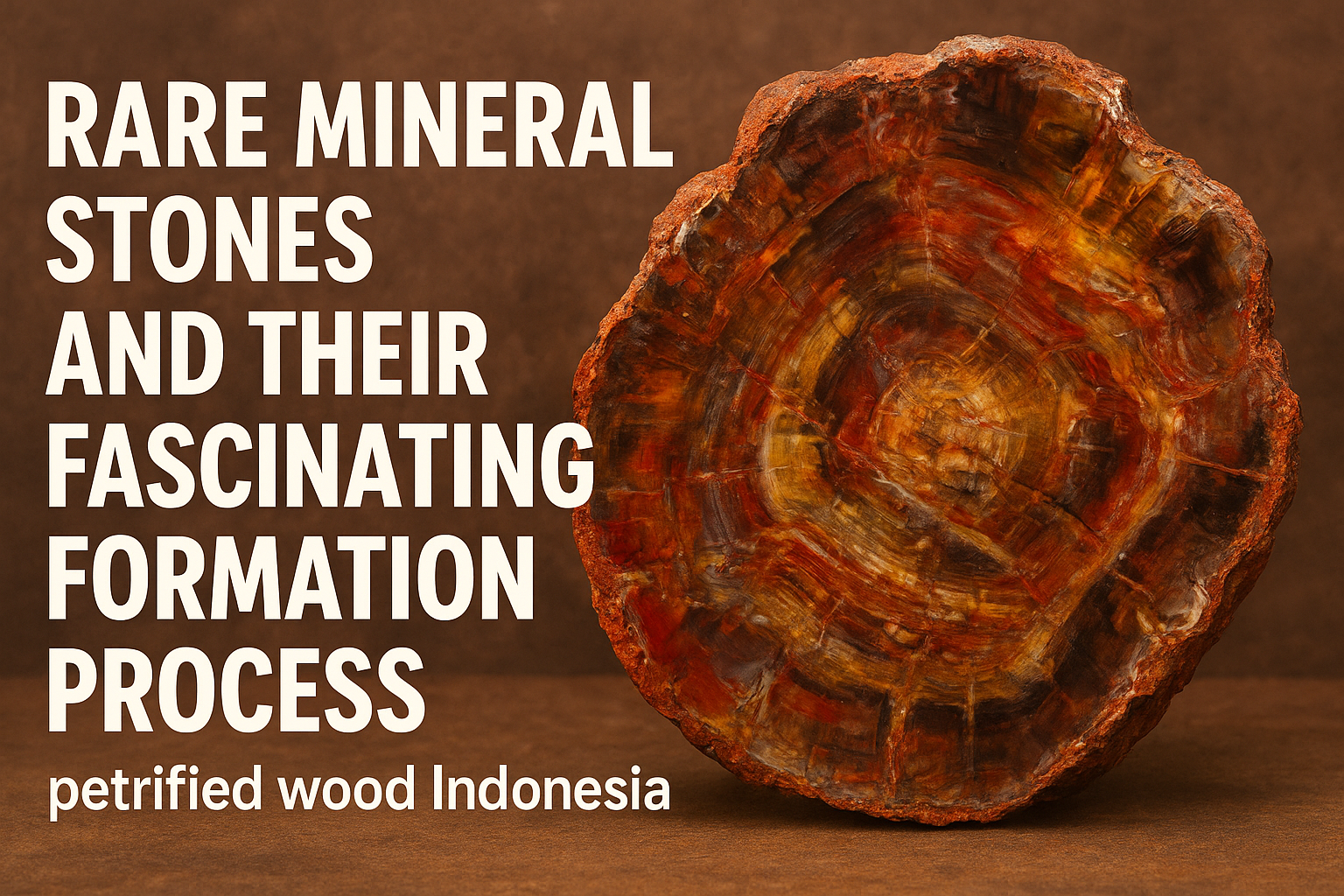
After thousands to millions of years, the transformation was complete. The wood became fully mineralized while retaining its original growth rings, bark patterns, and even microscopic structures. The result is petrified wood—a fossil that looks like wood but is as hard and durable as stone.
Indonesia, with its rich volcanic history and abundant mineral sources, provided the perfect environment for this transformation. Today, petrified wood Indonesia is recognized as some of the highest quality fossilized wood in the world.
Why Petrified Wood Indonesia is Globally Renowned
There are several reasons why Indonesian petrified wood has captured the attention of geologists, collectors, and designers worldwide:
- Exceptional Hardness and Durability
The high silica content makes petrified wood Indonesia extremely strong, almost as durable as quartz. - Stunning Color Variations
Mineral impurities such as iron, copper, and manganese create an array of colors—from golden yellows to deep blacks, reddish tones, and even hints of green. - Natural Artistry
The preserved growth rings, knots, and bark details make each piece unique, almost like a natural painting frozen in time. - Wide Applications
Beyond geology, petrified wood is used in luxury furniture, home décor, jewelry, and sculpture. In fact, many interior designers consider petrified wood Indonesia a statement piece for modern homes and hotels.
Comparing Petrified Wood to Other Rare Minerals
To understand its uniqueness, it helps to compare petrified wood with other rare minerals:
- Opal – Created from silica deposits, known for its iridescent play of colors.
- Malachite – A copper carbonate mineral recognized by its vivid green banded patterns.
- Labradorite – Famous for its blue, green, and purple flashes of light known as labradorescence.
- Amber – Fossilized tree resin that, unlike petrified wood, remains organic rather than mineralized.
What makes petrified wood Indonesia special is that it is not just a mineral but also a fossil, combining natural artistry and geological history in one piece.
The Role of Indonesia in the Global Market
Indonesia is one of the largest sources of petrified wood in the world. The regions of Java, Kalimantan, and Sulawesi are particularly known for their fossilized forests. Over the past decades, petrified wood Indonesia has been exported worldwide, admired for both its scientific value and decorative appeal.
In the global market:
- Collectors value it for its rarity and natural patterns.
- Museums showcase it as part of Earth’s geological history.
- Designers and architects use it for luxury interiors, such as tabletops, sinks, and even flooring.
This global demand has also positioned petrified wood Indonesia as not just a natural wonder but also a growing export commodity.
The Cultural and Spiritual Value of Petrified Wood
Beyond science and commerce, petrified wood carries deep cultural significance in many societies. In Indonesia, some believe that petrified wood symbolizes endurance, transformation, and connection to ancestral roots. Internationally, it is sometimes used as a healing stone, thought to promote grounding, stability, and patience.
Thus, owning a piece of petrified wood is not only about aesthetics—it is about holding a fragment of Earth’s history and energy.
The Geological Significance of Rare Minerals
Studying rare minerals like petrified wood provides scientists with valuable insights:
- Climate Clues – Fossilized trees reveal what ancient climates and ecosystems were like.
- Volcanic Activity – The presence of petrified wood in Indonesia highlights the country’s long history of volcanic eruptions.
- Earth’s Evolution – Minerals record geological processes that shaped continents, oceans, and life itself.
In this way, petrified wood Indonesia is more than just a collectible; it is a scientific archive of our planet’s deep past.
Preserving Rare Minerals for the Future
As demand increases, so does the need for responsible collection and trade. Overexploitation could threaten local environments or deplete fossil reserves. For this reason, sustainable practices are essential to ensure that petrified wood Indonesia remains available for future generations.